
Some of the most powerful innovation moments don’t begin with a roadmap or a lengthy discovery process. They begin when someone sees their idea come to life — right in front of them — and realizes it could actually work.
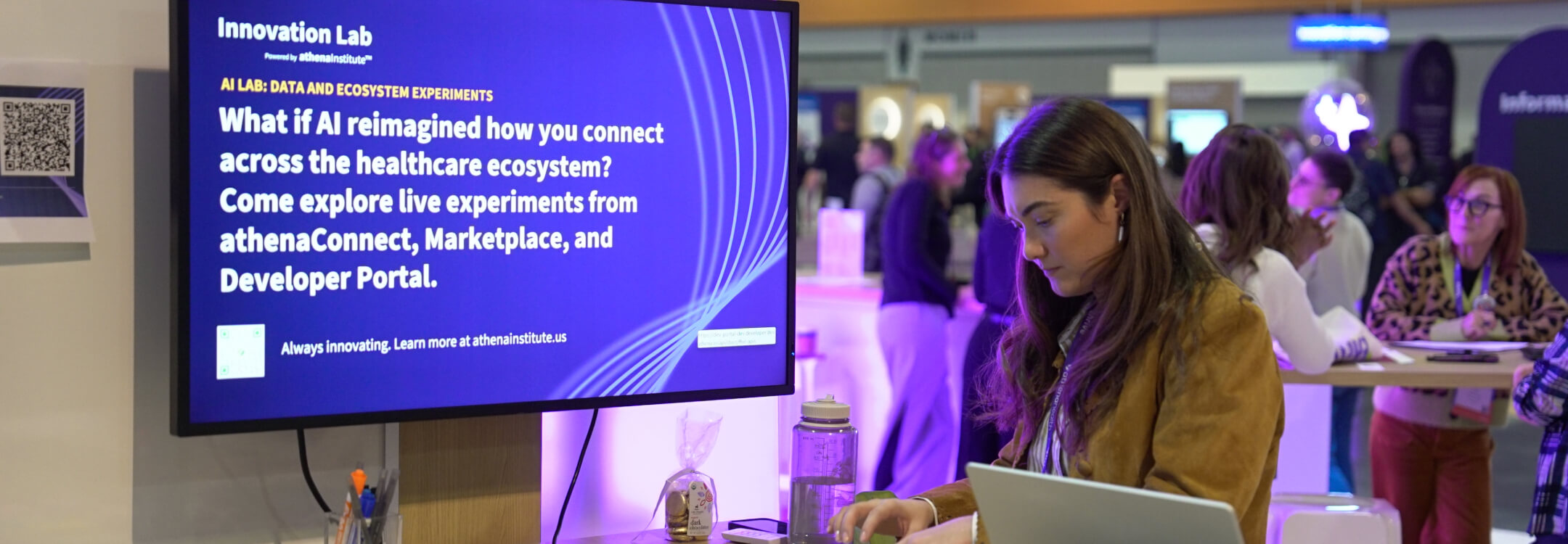
That was the spirit behind the Innovation Lab at Thrive, athenahealth’s annual customer symposium, this past November. From the start, the goal wasn’t just to ask customers what they wanted or to gather feedback in the abstract. It was to harness their ideas and show them on the spot how those ideas might work in practice.
Thrive brings together healthcare leaders, clinicians, and partners to connect around the future of healthcare. At the Innovation Lab, those conversations became something more tangible. The Lab was designed as a series of live, hands-on working sessions: quick, interactive, and genuinely engaging, but also deeply purposeful. Customers partnered directly with our design teams to interact with prototypes, participate in activities like whiteboarding and card sorts, and co-create solutions they could see and experience in real time — knowing those moments were actively informing the products we’re building.
As Executive Director of Experience Design and AI Innovation at athenahealth, I’m always looking for ways to deepen our understanding of users so we can arrive at the right experiences sooner. At Thrive, that understanding came into focus almost immediately.
Vibe-coding: Making ideas real, in real time
One of the most compelling experiences in the Innovation Lab was our AI-powered vibe-coding station. Customers visited the station with ideas they’d been carrying — some half-formed, others very specific — and watched as those ideas were brought to life right before their eyes.
Vibe-coding allows people who aren’t computer programmers to create software code with generative AI. The user describes an idea they have, or an outcome they want, in plain language. AI understands the intent and generates actual code, including a user interface. In this way, non-technical people can create apps and workflows that look and feel real — immediately.
Our R&D teams are already using vibe-coding to accelerate design and user feedback cycles. One team in our Data & Ecosystem division had a hunch that our clients might have ideas of their own they wanted to show us. At Thrive, that hunch was quickly validated.
Over the course of three days, customers generated more than 20 prototypes: everything from a work-from-home productivity tracking app, to a cough triage app, to a payer rules tracking app. Without AI, it would have taken months for our designers to co-create screen mockups with clients, and the results wouldn’t have been nearly as sophisticated. Instead, customers could see a functioning prototype instantly, then refine it further in conversation with our teams.
Customers partnered directly with our design teams to co-create solutions they could see and experience in real time — knowing those moments were actively informing the products we’re building.
What happens when physicians co-create with AI
As customers experienced the real-time potential of generative AI alongside our designers, several powerful things began to happen.
First, creativity blossomed.
One physician stopped by the vibe-coding station on day one and worked with our team to create an initial prototype. That night, interacting with his idea in a tangible way stayed with him. He spent the evening thinking about how to improve it, returned the next day, updated the prompt, and created a second version. Seeing and using his idea had unlocked new thinking almost immediately. Sometimes words aren’t enough — you have to feel an experience to understand what’s possible.
We also began to see resistance to AI adoption erode.
A neurologist shared that he’d been disappointed a year earlier when he tried an ambient product that hadn’t worked very well. But after experiencing the power of generative AI through vibe-coding — watching an idea become a working prototype in moments — he felt it was time to take a fresh look at how much the technology has evolved. He left the Innovation Lab with renewed optimism about AI and a willingness to try ambient products again.
Finally, we saw non-technical users express their problems and ideas to our R&D teams in entirely new ways.
One visitor, passionate about improving referrals, built a Referral Coordinator app at the vibe-coding station. After refining her ideal experience, she walked over to an athenahealth product team that is working on closed loop referrals across EHRs leveraging the 360X standard, and confidently walked them through her solution and rationale. Her idea didn’t live only in conversation: the experience she built turned her needs into something tangible, which helped the team understand both the problem she was solving and the solution she created.
Innovation as partnership, made tangible
For me, this is what innovation in healthcare should look like.
The Innovation Lab at Thrive showcased how athenahealth approaches innovation as a shared act. By harnessing cutting-edge AI like vibe-coding, we empower customers and teams to collaborate in new and meaningful ways, rapidly transforming ideas into something real.
This approach accelerates solution development by bringing the people who will actually use the software into the design process. It enables faster iteration, shared understanding across technical and non-technical participants, and solutions that genuinely address unmet needs. Just as importantly, it builds trust by showing customers that their ideas aren’t just heard, but explored, tested, and valued.
When we make innovation visible, fast, and collaborative, we don’t just build better technology. We build stronger partnerships. And those partnerships are what will ultimately move healthcare forward.
Liz Kelly is the Executive Director of Experience Design and AI Innovation at athenahealth.
More thought leadership resources

- Mia James
- September 08, 2026
- 6 min read
Why maternity care needed new CPT codes


Continue exploring
Read more actionable insights
Get thought leadership, research, and news about the business of healthcare.