

The Meaningful Use program for Medicare is divided into three stages. Each stage builds on the previous one over several years, to expand electronic health records usage to an increasingly larger patient population with a wider range of health care processes. The goals and requirements of the Meaningful Use stages are as follows:
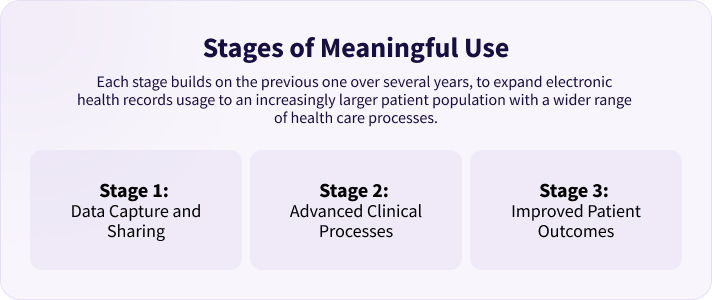
Meaningful Use Stage 1: data capture and sharing
Launched in 2011, Meaningful Use Stage 1 emphasizes proper electronic data capture and data sharing using an EHR technology. Eligible providers can attest to Stage 1 and receive their incentive payment after meeting nine core objectives and one public health objective.
Meaningful Use Stage 2: advanced clinical processes
Stage 2 Meaningful Use, which began in 2014, introduces new objectives and measures, as well as higher thresholds, requiring providers to extend EHR capabilities to a larger portion of their patient populations.
The recent changes to the Meaningful Use program have Stage 1 and 2 more closely aligned, with both requiring nine core objectives and one public health objective, for attestation.
Meaningful Use Stage 3: improved outcomes
Although details have not been finalized, Meaningful Use Stage 3 will aim to simplify the program, drive interoperability between electronic health records, and improve patient outcomes.
Based on the current timeline, providers have the option to begin Stage 3 Meaningful Use in 2017, but are not required until 2018.
Clinical quality measures (CQM)
Finally, all eligible providers must report on clinical quality measures (CQM), specifically nine out of 64 total CQMs. Providers must also select CQMs from three out of these six key health care policy domains, as recommended by the Department of Health and Human Services' (HHS) National Quality Strategy:
- Patient Engagement and Family Engagement
- Patient Safety
- Care Coordination
- Population and Public Health
- Efficient Use of Healthcare Resources
- Clinical Processes / Effectiveness
More PI & meaningful use resources

- Marty Fenn
- November 20, 2025
- 5 min read
Raising the bar on patient data privacy in athenaOne®

Continue exploring
Read more actionable insights
Get thought leadership, research, and news about the business of healthcare.


